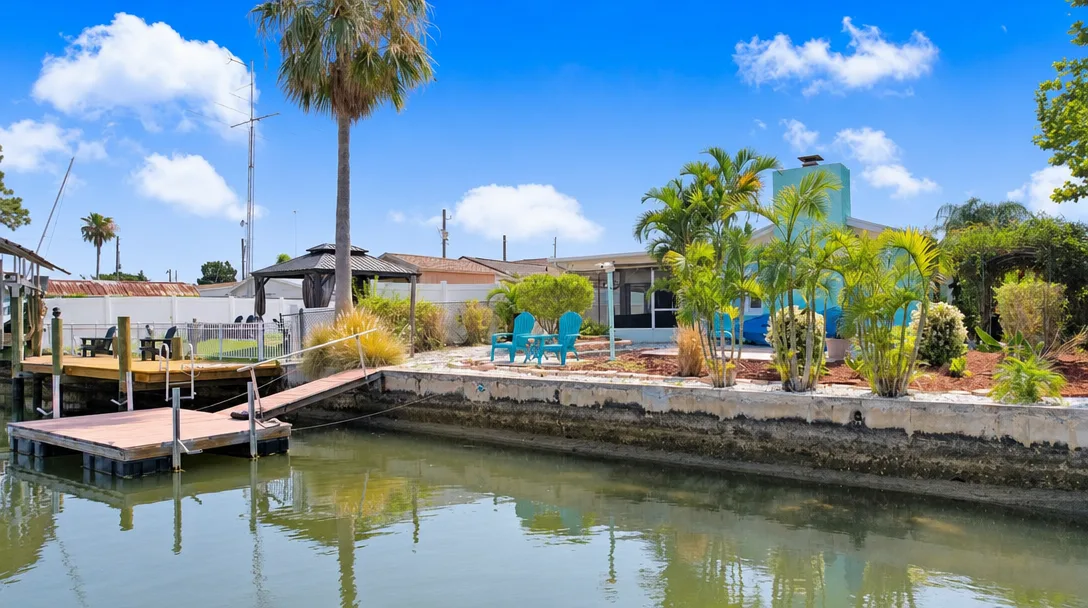
Canal homes are Hudson's most loved and most misunderstood purchase. The saltwater canals west of US-19 run straight to the Gulf of Mexico, and that access is what you are really paying for, so the value lives in the details: how deep the canal stays at low tide, how sound the seawall is, whether the dock is permitted, and what flood insurance actually costs. Here is what Hudson buyers should check before making an offer.
We are Paul and Denise Virgadamo, a husband-and-wife team at Dalton Wade Real Estate Group, and we live and sell in west Pasco every week. With more than 45 years of Tampa Bay roots and over 1,000 homes sold across Pasco, Pinellas, and Hillsborough Counties, we have watched the canal market here from both sides of the closing table. Hudson is one of the most affordable places on Florida's Gulf Coast to own waterfront property, and that affordability comes with homework. The buyers who do it well get a boater's lifestyle at a price that would be unthinkable further south, so this guide walks through the real numbers, the inspections that matter, and the financing edge that most buyers overlook.
What Canal Homes Actually Cost in Hudson Right Now
Hudson spans two main ZIP codes with different personalities. The 34667 area (Hudson's beachside and older canal neighborhoods) shows a median sale price around $289,000 over the last three months, up slightly year over year, with hundreds of sales on record. The 34669 area (further inland, by the SunWest and Beacon Square corridor) sits closer to $307,000. Citywide figures land in the mid-$280,000s to low-$300,000s depending on the source, which makes Hudson one of the most affordable waterfront ZIP corridors in the entire Tampa Bay region.
The negotiating picture has shifted too. Most Hudson homes now close about 1% to 3% below asking, and the 34667 area averages roughly 66 days on market, so motivated sellers are open to price discussions, closing-cost credits, and repair negotiations in a way they were not a few years ago. Right now roughly 45 to 75 canal-front homes are listed for sale across Hudson depending on how the filter counts them, which means genuine choice, and genuine room to be selective.
One caveat before you get excited: median price and canal price are different animals. A canal lot with Gulf access almost always carries a premium over a landlocked home in the same subdivision, and that premium is exactly what you are buying. The right way to look at a canal home is not "is it priced like the neighborhood median?" but "is it priced fairly for what the water access and condition actually deliver?" That is the question the rest of this guide helps you answer.
Canal Depth and Gulf Access: The Boat Question
The first thing Hudson buyers ask us is whether their boat will actually get out. Most of Hudson's canal communities, including Hudson Beach Estates, Gulf Harbors, Sea Pines, Signal Cove, Cape Cay, and Sea Ranch on Gulf, sit on dredged saltwater canals that connect directly to the Gulf with no bridges in many cases, which is why listings advertise "direct Gulf access, no bridges, no tide restrictions."
Here is what the marketing copy will not tell you: canal depth varies by neighborhood, by individual canal, and by how long it has been since the county last dredged. Pasco County maintains and has dredged the main channels serving these communities, but a study commissioned by the county flagged shallow secondary canals, the ones running from individual docks to the main channel, as a real navigability concern. In plain terms, your dock might sit in 6 feet of water while the canal mouth silted to 3 feet at low tide, and the listing will not say that.
- Ask for a depth and sounding survey of the full route you will actually boat. Not just the water directly in front of the dock, but from your slip to open water, measured at low tide. Match it to your boat's draft, and remember that a bigger boat draws more water than the number on the brochure.
- Confirm the neighborhood's channel is on the county's maintained and dredged list. West Pasco channels have been studied for dredging needs, and some secondary canals were flagged as shallow. Your agent should know which canals have been cleared and which are marginal.
- Check clearance for anything above the waterline. Even where there are no bridges, verify the route for cables, low spans, and canal width for docking and backing out.
- Boat before you buy. If you can, run the route yourself at a normal weekend tide. An hour on the water tells you more than any listing photo.
None of this means Hudson canals are a bad bet, far from it. It means depth is an address-specific, measurable fact, not a neighborhood rumor, and the buyers who treat it that way never end up with a boat that cannot leave the dock.
Seawalls and Docks: What to Inspect, and What Repairs Cost
Your seawall holds your yard out of the canal, and it is the most expensive thing you will never see in the listing photos. Pasco County requires a building permit for docks and seawalls, with scaled site plans and contractor information, so a permitted waterfront improvement is a genuine signal. Work on state submerged lands or navigable waters can also require Florida DEP authorization and U.S. Army Corps of Engineers permits, another reason permit history matters.
Seawall problems are common in saltwater canals and they do not announce themselves at a casual walk-through. A failing or failed seawall commonly costs $20,000 to $100,000 to repair, and a full replacement runs $25,000 to $100,000, roughly $500 to $1,200 per linear foot for concrete and $400 to $1,200 for vinyl in Pasco. That is a number you want discovered before you sign, not after.
- Walk the seawall with your inspector and look for the classic failure signs: cracked or displaced cap, rusted or leaning panels, voids or sinkholes forming behind the wall, and eroded tiebacks. A wall can look fine from the dock and be failing from behind.
- Ask for the permit and repair record. When was the wall built or replaced? Any repairs, and what did they address? A wall with a documented history and a recent inspection is worth far more than one with none.
- Inspect the dock and boat lift the same way. Check piling condition, decking, wiring and breakers, and whether the lift is permitted and sized for the boat you actually own.
- Remember that flood insurance does not cover docks or seawalls. NFIP policies are designed for the structure, not the improvements over water. Damage to a dock is typically an uninsured loss, so maintenance condition is really a budget question.
A well-maintained seawall and a permitted dock add real value to a Hudson canal home, and they are among the best negotiating points a buyer has when the records are thin. Sellers who keep waterfront paperwork win buyers' confidence, and buyers who ask for it never get surprised.
Flood Insurance and Elevation: The Paperwork That Matters
Canal homes sit in a FEMA Special Flood Hazard Area in most of Hudson, typically coastal AE zones with base flood elevations around 8 feet in Pasco County. In plain terms, if you use a federally backed loan (FHA, VA, Fannie Mae, or Freddie Mac), flood insurance is mandatory at closing, and your lender will verify coverage before you sign.
- Get the elevation certificate. It records the lowest floor height relative to the base flood elevation, and it is the single most useful document a canal buyer can request. Pasco County's building department keeps elevation certificates on file for newer construction, and an older home may have one from past work or refinancing. A home built or raised to the standard insures at a very different premium than one sitting at ground level.
- Budget flood insurance into the offer from day one. Ask for a real quote on the specific property before you negotiate, not an estimate. In flood-aware neighborhoods, the monthly insurance number belongs in the same conversation as the mortgage payment.
- Know the 50% rule. If a building in the floodplain is substantially improved or damaged by more than 50% of its market value, it must be brought up to current flood standards, which can mean elevation. That is a big future cost if you are planning major renovations.
- Ask about grandfathering. Pre-1975 homes with continuous flood coverage may qualify for older, more favorable rates, and that history can be worth real money. Your insurance agent can confirm what applies to the specific property.
- Expect a four-point inspection on older coastal homes. Roof, electrical, plumbing, and HVAC, often required by insurers before they will quote. If the roof is near the end of its life, that is a negotiation item, not a surprise.
Flood risk is a reason to be careful in Hudson, not a reason to avoid it. What separates a smart waterfront purchase from a painful one is knowing the elevation, the premium, and the claims history before you commit. An informed buyer can find an elevated home with a recent roof and a reasonable insurance quote, because those homes exist here in volume.
The Financing Edge Few Buyers Know About: Assuming a VA Loan
With mortgage rates above 7%, the single biggest money move a Hudson buyer can make this year is one most people have never heard of: assuming a seller's VA loan. A VA loan assumption lets you take over the seller's existing mortgage at its original interest rate, which for many Hudson canal homes means a rate in the 3% to 4% range, sometimes lower, in a 7% market. The monthly savings are often hundreds of dollars, every single month, for the life of the loan.
The surprise for most buyers is that you do not need to be a veteran to assume a VA loan. Anyone can assume one with the lender's approval. The rules shook out like this in 2026:
- The lender approves you, just like any mortgage. Most servicers look for credit near or above 620 and a debt-to-income ratio at or below about 41%, though compensating factors can help.
- You pay a 0.5% VA funding fee on the remaining balance. That is the same low rate as a refinance, far below the 2.15% to 3.3% charged on a brand-new VA purchase, and some buyers are exempt. A processing fee of a few hundred dollars applies too.
- The catch is the equity gap. You pay the difference between the sale price and the remaining loan balance, in cash or with a second loan. A seller who bought years ago with a low balance means a big cash requirement, so the math only works when you can cover the gap.
- Plan for a longer timeline. Servicers can take 30 to 60 days or more to approve an assumption, so your contract needs a closing date that gives the process room. A VA-experienced lender and agent make this routine.
- Know the entitlement quirk. When a non-veteran assumes the loan, the seller's VA entitlement stays tied to the property until it is paid off. Only an eligible veteran who substitutes their own entitlement can release it early, which is a detail sellers should understand too.
A growing number of Hudson canal listings note whether the current financing is assumable, and our office checks the financing angle on every waterfront property we show. In this rate market, the assumed rate can be worth more than any price negotiation, and it is fully legal, fully available, and wildly underused.
Why the Hudson Waterfront Pulls Buyers In
The canal is the headline, but the life around it is what closes the deal. Hudson Beach Marina and Fisherman's Pier put you minutes from launch ramps, charters, and seafood dining at the water's edge. SunWest Park brings a white-sand beach and a spring-fed lake right in town, and the Florida Exotic Bird Sanctuary gives families a genuinely one-of-a-kind afternoon. The fishing is the culture: low-impact, saltwater, out your back door.
The neighborhoods fit different buyers. Gulf Harbors and the beachside canals draw boaters and retirees who want the water as a lifestyle, with active 55+ communities nearby. Hudson Beach Estates and Sea Pines offer classic Florida ranch homes with canal lots and quick Gulf runs. More inland, the 34669 corridor gives families a lower entry point with the same schools and the same sunset. If you are weighing the full picture, our Hudson community guide walks through the neighborhoods, dining, parks, and events in detail. For the deeper daily-life view, our Hudson lifestyle guide covers the local calendar end to end.
The one thing to keep in perspective: Hudson sits at the northern edge of the Tampa Bay region, and the trade-off is part of the value. You give up some commute convenience and gain waterfront ownership at a price per square foot that barely exists anywhere else on Florida's Gulf Coast.
How to Shop Hudson Canal Homes Like an Advisor
If you are starting your search, here is the checklist we run with buyers before their first Hudson canal tour:
- Get pre-approved with the flood insurance already in the number. Ask your lender to model taxes and flood insurance into the payment so the price you qualify for is the price you can actually carry.
- Pull the depth data before you fall in love. Request a depth and sounding survey at low tide for any canal you are serious about, and take the boat's draft with you when you read it.
- Run the seawall and dock inspection early. The waterfront improvements are the most expensive systems on the property, and their condition is negotiable when the records are thin.
- Ask for the paperwork file. Elevation certificate, flood claims history, seawall permits and repairs, dock permits, roof age, and insurance quotes belong on the table before you negotiate.
- Ask about the financing before you make an offer. If the seller has an assumable VA loan at a below-market rate, that changes the entire economics of the deal. We check this on every waterfront property.
- Keep your contingencies. Inspection, appraisal, insurance, and financing are yours to keep in this market. The seller who wants a clean closing will work with you, not against you.
Tampa Bay overall sits in a balanced market in 2026, but canal-front Hudson is its own game: affordable saltwater access, a boater's lifestyle, and paperwork that rewards the buyers who ask the right questions.
The Bottom Line from Team Virgadamo
Here is the summary we would give our own family: Hudson canal homes are one of the best waterfront values in Florida, as long as you verify the depth, inspect the seawall and dock, budget the flood insurance, and check whether the seller's loan is assumable. Do those four things and you can own Gulf access at a price that surprises everyone from the coast.
Who you hire truly matters. We have bought, sold, and lived in this market for over 45 years, closed more than 1,000 homes, and we know the difference between a waterway bargain and a waterway headache. Start with our Hudson community guide, then let's look at your numbers together. We Live, Love & Sell Tampa Bay!
Ready to run the numbers on a Hudson canal home?
Let's pull the sold data, check the depth, seawall, and insurance picture, and see whether an assumable VA loan changes the deal. Schedule a free, no-obligation consultation with Paul and Denise Virgadamo.
Explore our communities: